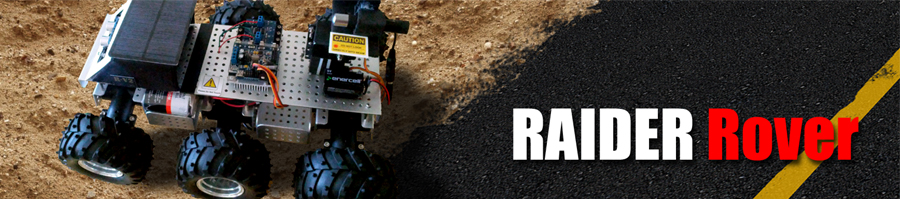
Introduction
The Raider Rover first began as a brainstorm of ideas for a senior project by Albert Nera and Andrew Ahmad, both seniors in the Engineering Technology (E.T.) program at California State University Long Beach(CSULB). The goal of the senior project under CSULB’s Engineering Technology* program is to demonstrate the application of different types of electronic components and/or micro-controllers working together as a single system that is designed to accomplish a certain task or group of tasks.
Initially Albert and Andrew had their own ideas of the direction for the senior project. For example, Albert’s focus was on creating a project that explored the use of a single or pair of micro-controllers to create a self-contained autonomous system while Andrew focused on exploring the use of remote control for a system of integrated electronics including servos and DC motors.
As a result of the different ideas for the project, the concept of creating a rover was not fully agreed upon right from the start. In fact, Albert had initially conceived of exploring the topics of autonomous control systems in the form of a drone project instead.
The drone would have been built either from scratch or built on the frame of an off the shelf RC plane. This idea had been conceived a year earlier so research and experimentation related to motor-controllers and developing a design for a drone had already begun a couple months earlier. However, as a result of the collaboration with Andrew, it was necessary to rethink the overall direction for the project and get his opinion and insight regarding electronics and electrical theory.
Design and Development
After some brainstorming and debating the consensus was that the project would take the form of a rover. The rover would try to integrate as much of the technology and ideas that both team members wanted to explore. An initial proposal for the project was filed which stated that the rover would consist of a metal chassis with a centrally positioned micro-controller based on the Arduino.
The rover would be operated using remote control and a wireless camera system would transmit a video signal to the operator to allow steering and movement from up to a distance of 50 feet. On board sensors for autonomous operation would also be considered as part of the project.
In addition to finalizing the proposed design, the rover was also given the designation of Raider. This nickname was given simply for the “cool factor” at first, but was adopted as the official name for the project.
Once the initial proposal for a rover project was established. A more concrete design had to be put on paper, materials acquired and total cost determined for the project.
The proposal submitted for the project would remain for the most part a solid guideline for the final design of the rover but during the assembly of the rover details such as exact dimensions and materials used for the structure of the rover were continuously debated.
Albert believed that it would probably be more favorable to build a small four wheeled rover and use some of the parts he had already acquired for conducting testing for the drone project. This would save time and reduce cost. Overall the vision Albert had for the design of the Rover was of a quickly assembled rover that was constructed with low-cost off-the-shelf components that could be easily tested, integrated and replaced as needed while still keeping the budget down to the bare minimum.
Andrew on the other hand wanted to pursue a more sophisticated six wheeled rover and invest in specific parts that he had researched and felt would provide greater durability and flexibility for the project. These parts were more costly and the time to acquire them from the supplier had the potential of significantly delaying completion and final testing.
With all the back and forth research and brainstorming as well as busy schedules with work and other university courses, it soon became apparent that the project would be racing against the clock.
Andrew’s reassurance that he could promptly acquire the necessary components he had been carefully researching and his willingness to provide the necessary funding for those parts ultimately led to the decision to go ahead with Andrew’s approach.
However, at the same time Albert had decided to go forth with the development of a smaller version of the rover using some of the components and materials he already had available. The smaller rover nicknamed Raider M (M for mini) was not intended to be a competitor project but rather a platform he could use to test code and sensors on his own time while Andrew began to assemble and test the larger Raider Rover. In a worst-case scenario Raider M would also act as a back-up project and submitted if unfortunately the larger RAIDER could not be completed on time.
Completion and Preservation
After a period of 4 months designing and building the project the Raider rover was finally completed but not before the project reached a final price tag of nearly $400 and cut backs had to be made on the ambitious idea of integrating a multitude of sensors for autonomous capabilities.
The final version of Raider that was submitted as the senior project did at least accomplish the core objectives such as integrating remote control capabilities and demonstrating the use of few sensors paired with a micro-controller to control the illumination of LED headlights and process input sensor information for use in a future autonomous system.
Once the completed rover had been submitted and presented it was time to determine the ongoing future for the project. In light of the heavy investment of time and money dedicate to the rover Albert felt Raider should remain intact despite talk of disassembling it in order to reuse the individual parts in other projects or sell off as used hardware to recover some of the money that was spent on the project. In the end Albert took full possession of the project with the intent of reserving it and reimburse his fellow team member, Andrew, for the amount he had initially invested to get the higher-end components. With the Raider rover preserved it became possible to explore ongoing development of the project at a future date and allowed it to be showcased at events like the open-house of the Engineering Department.
* The Engineering Technology program is under the Electronics Engineering Department of CSULB. The program is intended to provide students with basic theory behind electronics and computer systems in order to apply the technology for research and industrial applications. The range of topics covered in the program has resulted in graduates going into a variety of industries including Aerospace, Manufacturing, Green Energy and Consumer Electronics.